CAMDEN, N.J. — For decades, residents of Camden have seen local news operate as a hit-and-run enterprise. A reporter arrives, asks probing questions during a moment of crisis, collects quotes, and leaves. Once the story goes live, the newsroom moves on, leaving the community with the sense that media is something that happens to them rather than with them.
For the past seven months, the South Jersey Emerging Journalists Project has been working to break that cycle. Through a partnership with Temple University’s Center for Community-Engaged Media at the Klein College of Media and Communication, the project brings journalism training, storytelling tools, and reporting opportunities directly into the city.
The strategy is straightforward: Treat residents not merely as sources to be tapped for information, but as equal partners whose lived experiences shape the narrative.
In places like Camden, where negative coverage has historically overshadowed local resilience, changing that dynamic requires more than good intentions. It demands a physical, reliable presence. Fellows in the program undergo training that extends beyond interviewing techniques. They learn active listening, relationship-building, and the logistics of long-term engagement.
At the forefront of training our fellows was Derrick Cain, who serves as the senior engagement consultant for CCEM.
"Partnering with the South Jersey Emerging Journalists Project and Temple University’s Center for Community-Engaged Media was a deeply meaningful experience, Cain said. “This work serves as a constant reminder that community engagement in journalism functions as both a process and an outcome.”
Over months of consistent presence, that sustained commitment has begun to pay off in growing open communication across the neighborhood.
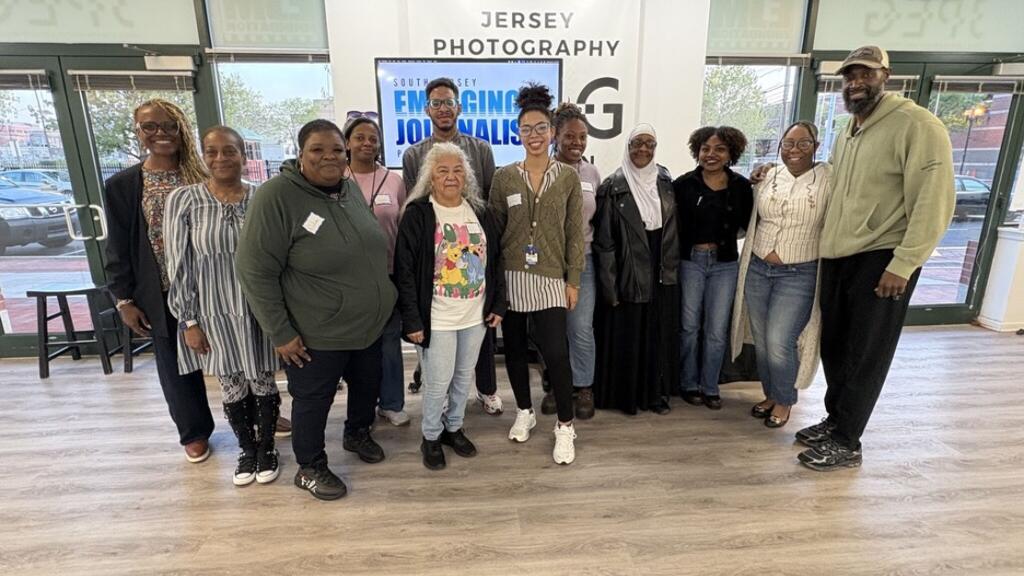
A clear illustration of this method in action took place during a community roundtable series hosted at JPEG Gallery in Camden. The gatherings brought residents and emerging journalists to the same table, transforming a typical interview into an open conversation. Instead of answering fixed questions, community members talked through daily realities, systemic issues, and local victories, actively co-developing story ideas. For the fellowship cohort, those exchanges reframed their understanding of civic reporting.
Residents offered grounded expertise that illuminated crucial stories traditional newsrooms routinely miss. At the same time, the process gave fellows a heightened sense of professional duty. Accuracy and ongoing follow-through became just as vital as filing the initial draft. That methodology aligns directly with the mission of Temple’s Center for Community-Engaged Media, which provides academic backing and research frameworks for engagement-focused reporting. The academic partnership reinforces a core premise: Journalism should function as a continuous public service rather than a series of isolated transactions.
“As a process, it hinges on building authentic relationships that enable community members to participate throughout the entire reporting journey,” Cain said. “As an outcome, it drives the ultimate goals we strive for daily. Together, we aim to deliver more trustworthy, accurate, and impactful storytelling for the communities we serve."
Now, the project is moving into its crucial production phase. Story concepts born out of the gallery roundtables are being developed into full-length news reports. Closing this loop is critical to establishing long-term credibility. It proves to participants that their contributions do not vanish into an editorial void once the meeting ends.
“We want to produce something that shows the community that we listened to them and we can be trusted,” Velvet S. McNeil, SJEJP Executive Director said.
That intent was evident at a follow-up gathering where fellows returned to Camden to present work in progress. Rather than treating the event as a final presentation, organizers set it up as a progress report. Residents watched their ideas take shape in real time, offering feedback while reporters refined their coverage. The atmosphere emphasized joint effort over formal critique, demonstrating what happens when journalists maintain an ongoing dialogue with the public. It served as a practical reminder that civic engagement only succeeds when it leads to clear, visible outcomes.
The initiative’s footprint continues to grow beyond scheduled roundtables. Erik James Montgomery, owner of JPEG Gallery, plans to host future workshops and public meetings, providing more opportunities for residents to learn media skills while giving fellows space to deepen their reporting. Simultaneously, the project is constructing a digital community asset map that highlights local institutions, grassroots organizations, and neighborhood leaders. The mapping effort will continue into 2026, offering a permanent resource for future reporters and residents alike.
To maintain operational transparency, SJEJP documents its ongoing work and makes selected materials available through its digital platforms.
As the next step of our collaboration, CCEM will work to develop a community asset map focused on Camden County. The work will be similar to recent efforts CCEM made in Delaware County, Pennsylvania.
“We are pleased to continue to work with this important project serving the information needs of South Jersey residents,” Crittenden said.
At its core, the collaboration between SJEJP and Temple University offers a blueprint for a healthier media ecosystem, one built on physical presence, authentic participation, and genuine accountability. After seven months on the ground in Camden, mutual trust is starting to take root. The ultimate success of the project won't be measured by awards or click rates, but by its legacy. If the model succeeds, it will prove that local news is most powerful when it works alongside the community to give something meaningful back.