
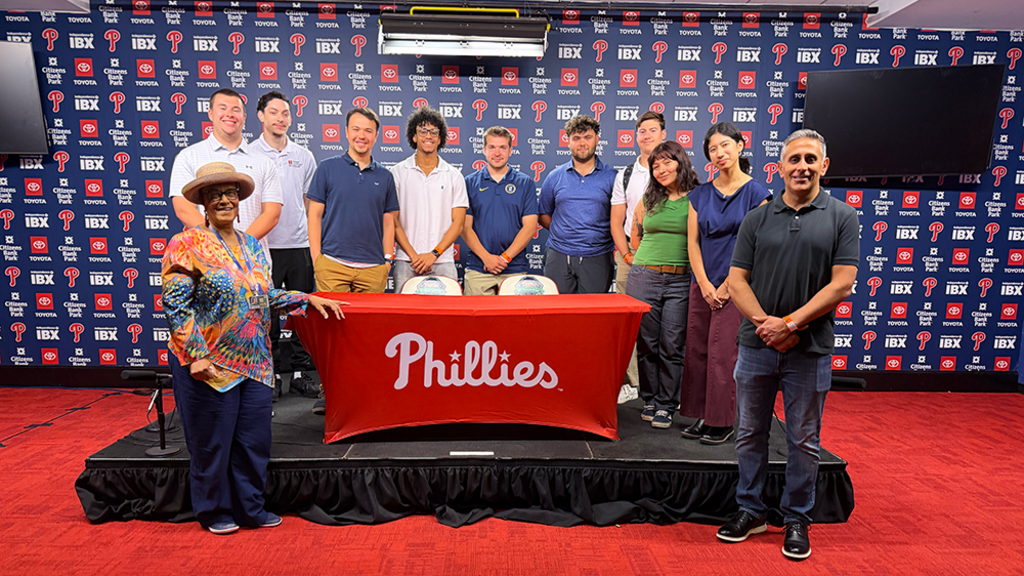
Photo by Amanda Stankiewicz
When someone first starts a career in sports media, their dream often involves reaching the highest levels of the industry and interviewing the professional players and coaches they watch on television.
A group of more than 10 Temple University Klein College of Media and Communication students majoring in Sports Media or involved with the Claire Smith Center for Sports Media had the opportunity to experience a glimpse of that reality when they interviewed Philadelphia Phillies manager Don Mattingly and Los Angeles Dodgers manager Dave Roberts a few hours before the two teams played Tuesday, July 21 at Citizens Bank Park.
Following a visit to the Phillies’ press box overlooking home plate, students went down to the club’s media room, where they spent nearly an hour asking questions of the two managers and former Major League Baseball players.
“It's surreal,” said Colin Schofield, a 2026 journalism graduate who just started his first job in the industry as the sports editor at The Goshen News in Indiana, where he will lead the paper’s high school sports and Notre Dame coverage. “Baseball's been my favorite sport since I was 6 years old. Dave Roberts and Don Mattingly have been two managers, two players. I didn't watch them play, but I knew them as players. But two people in baseball who I've known about and honestly been major figures for 15 years for me, and it was super cool to be in the same room as them to do a press conference-type interview with two managers who I'd love to interview as a credentialed media member someday.”
The pregame media session was arranged by Claire Smith, the founding executive director of the Claire Smith Center for Sports Media. Smith covered both Mattingly and Roberts during their playing and managerial careers and later recruited them to serve on the Center’s steering committee.
Students asked a wide range of questions, from life outside baseball to game management decisions and roster considerations.
“Since I was a kid I would go to sleep tossing and turning about a bullpen move that stuck with me or a decision to pinch hit a guy I wasn’t happy about, just wishing I could ask the Phillies manager why he did it,” said Mike Livingston, a first-year sports media major. “So it was kind of cool when I got the chance to sort of do that for real.”
One discussion centered on how managers handle the pressures that come with leading professional teams and the constant scrutiny that accompanies the job.
Both Mattingly and Roberts said they avoid social media, and Roberts even said he tries to get his players to not look at what is being said about them. While they know that they can’t completely take away the negative press, it's about trying to limit their consumption of it.
“I don't do social media,” Roberts said. “I kind of guard against stuff like that for my own sanity. But at the end of the day for me personally, I have my faith and so it's like, ‘Hey, whatever, I'm gonna do my best and I don't need this game. I love this game. I love coaching and managing, but I just do the best I can.’”
The managers also offered advice to the journalists on what they wished they were asked by media members. Most of it centered around being fair and prepared, and both managers said they often try to shed light on players who aren’t always getting the credit they deserve.
“We can be nice and polite and then talk about the people we want to talk about,” Mattingly said. “So even though we may want to talk about something, if you don't bring it up, we can take it where we want. I think it's one of the things you learn over time. For me, I started writing things down during the course of the game.”
For the students, the experience provided more than just access to two of baseball’s most respected managers. It offered a chance to practice interviewing skills in a professional environment and gain a deeper understanding of the relationship between athletes, coaches and the media.
“To have an hour to ourselves with the managers of some of the best teams in baseball right now, it’s insane to think about it,” said Francine Rodriguez, a junior media studies and production major. “They treated our questions like the real deal and not some mock practice class, which was seriously appreciated. I learned a lot about how it is to be in a sports press room and how to formulate good questions on the fly thanks to this.”